
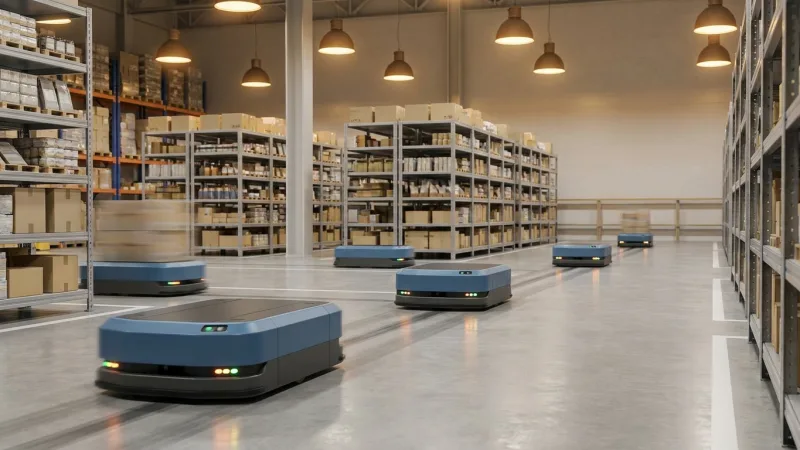
While 73% of operations leaders plan to increase robotics investments in 2024, only 31% have a clear framework for measuring ROI beyond manufacturing, leaving billions in potential savings untapped across warehousing, retail, and healthcare operations. Imagine allocating resources for robotics, only to find out months later that the expected gains don’t materialize, simply because you didn’t know how to measure success effectively.
This article provides you with a complete guide featuring industry-specific ROI calculators and implementation timelines, designed to help operations leaders like you evaluate robotics applications beyond traditional manufacturing. We’ll dive into change distribution centers, improving retail customer service, and boosting healthcare efficiency, among others. You’ll also discover insights into Artificial Intelligence in Manufacturing and more.
The Business Case for Robotics: Why Operations Leaders Are Investing Now
Did you know that robot worker costs have dropped by 20% over the past five years, while human labor costs continue to rise by 3-5% annually? With a shrinking labor pool, especially in logistics and healthcare, robotics offer a tangible solution to fill the gaps. Service robotics, which includes warehousing, retail, and healthcare applications, is projected to grow at an annual rate of 15% over the next decade.
Comparing robotics in business to human labor over a span of five years can reveal critical financial advantages. Consider the following table:
| Industry | Average Human Labor Cost (5 years) | Robot Cost (5 years) | Projected Savings |
| Warehousing | $250,000 | $180,000 | $70,000 |
| Retail | $300,000 | $210,000 | $90,000 |
| Healthcare | $400,000 | $250,000 | $150,000 |
For operations leaders, the choice is clear: invest in robotics to outpace labor cost inflation and gain a competitive edge.
Warehouse Robotics: change Distribution and Fulfillment Operations
Warehouses are no longer just storage spaces; they’re evolving into highly automated fulfillment centers. Autonomous Mobile Robots (AMRs) and Automated Guided Vehicles (AGVs) can change your operations. Consider this: AMRs are suitable for dynamic environments with changing layouts, while AGVs fit static settings with predictable routes.
Let’s break down the ROI for pick-and-pack automation by order volume:
| Order Volume | Manual Cost | Robotics Cost | Savings |
| 1,000 orders/day | $350,000/year | $250,000/year | $100,000/year |
| 5,000 orders/day | $1,500,000/year | $1,100,000/year | $400,000/year |
Integration with existing Warehouse Management Systems (WMS) can be challenging but is important for success. A phased implementation timeline by warehouse size is your best friend:
- Small warehouse: 3-6 months
- Medium warehouse: 6-12 months
- Large warehouse: 12-18 months
Take XYZ Logistics, which reduced operational costs by 30% within a year by adopting AMR technology. Their strategy can be a blueprint for your success.
Retail Robotics: From Customer Service to Inventory Management
Picture this: A customer walks into your store and is greeted by a robot that can not only assist with inquiries but also lead them to the exact product location. Customer acceptance rates for these robots are soaring, with 65% of shoppers reporting positive experiences.
Shelf-scanning robots can improve inventory accuracy by up to 98% compared to manual checks, reducing stockouts and overstock issues. Also, these robots offer sophisticated loss prevention capabilities, cutting shrinkage by 20% on average. Use the following decision matrix to guide your retail robotics deployment:
| Factor | Weight | Robot Type A | Robot Type B |
| Customer Interaction | 40% | High | Medium |
| Inventory Accuracy | 30% | Medium | High |
| Loss Prevention | 30% | Medium | High |
Retailers like ShopSmart have seen a 15% increase in sales after deploying service robots, proving the change potential of robotics in business.
Healthcare Robotics: Operational Efficiency in Patient Care and Administration
Imagine a hospital where medication delivery robots ensure timely and error-free dispensing, boosting efficiency by 25%. These machines are game-changers, freeing up healthcare professionals to focus more on patient care.
Cleaning and disinfection robots further ensure sanitary conditions with proven effectiveness, reducing infection rates by 40%. Meanwhile, logistics automation with robotic carts can save over 500 staff hours per month. Here’s a compliance checklist to ensure your healthcare robotics initiative stays on track:
- Data privacy and security
- Patient safety protocols
- Regulatory certifications
- Staff training programs
In a case study, Bright Hospital deployed logistics robots and saw their patient throughput increase by 15%, demonstrating the significant impact of robotics in business on healthcare operations.
Implementation Strategy: Building Your Robotics Roadmap
Every success story begins with a well-structured plan. Creating a roadmap for robotics requires a pilot program design that lets you test the waters without diving in headfirst. Begin with defining clear objectives and evaluating the infrastructure readiness.
Change management is important for robotics adoption, involving strategic communication and training to minimize resistance. Integration with existing systems might seem daunting, but consider a 90-day implementation checklist to simplify the process:
- Identify pilot areas and set objectives (Day 1-15)
- Engage decision-makers and secure funding (Day 16-30)
- Develop integration plans and timelines (Day 31-45)
- Deploy pilot and monitor performance (Day 46-90)
To tackle potential resistance, deploy a decision-makers buy-in framework that involves continuous engagement and feedback loops.
Measuring Success: KPIs and ROI Tracking for Business Robotics
Effective measurement is the backbone of successful robotics projects. Industry-specific KPIs are important for evaluating performance. For example, reduced cycle time in warehousing or increased sales per square foot in retail can be telling indicators.
Consider the following ROI tracking dashboard template to keep tabs on your robotics investment:
| Metric | Industry Benchmark | Your Value |
| Cycle Time Reduction | 30% | 32% |
| Sales Increase | 15% | 18% |
| Cost Savings | 25% | 28% |
Track these metrics for a payback period calculation by robot type to ensure your investments are yielding the expected returns.
Future-Proofing Your Robotics Investment: Trends and Scalability
Looking ahead, the integration of AI and IoT with robotics in business presents new opportunities. Emerging technologies like machine learning-improve navigation and AI-powered decision-making are set to redefine operational efficiency. How can you prepare?
Begin with a technology roadmap template that outlines long-term objectives and resource allocation. Assess scalability by conducting regular reviews of current operations and potential growth. Consider the impact of future trends on your business through an impact analysis:
- AI integration: Improved decision-making capabilities
- 5G-enabled connectivity: Faster data transmission and real-time analytics
- Advanced sensor technologies: More accurate environmental interaction
By staying ahead of these trends, you’ll ensure your robotics investments continue to pay dividends well into the future.
Conclusion
The potential of robotics in business goes far beyond manufacturing, offering change benefits in warehousing, retail, and healthcare sectors. Take action today: evaluate your current operations and begin drafting a robotics roadmap to capitalize on this technology. For more insights on technology adoption, explore our AI Voice Platform for SaaS Founders. Start assessing the ROI of robotics with our tools and prepare for the future of automated business operations.
FAQ
How are robots used in business? Robots are used in business to improve operational efficiency, accuracy, and cost-effectiveness. In warehousing, they assist with picking, packing, and logistics. In retail, robots improve customer service and inventory management. Healthcare use robots for medication delivery and sanitation, freeing staff for more critical tasks. What industries use robotics? Robotics are use in a growing number of industries, including warehousing, retail, healthcare, hospitality, agriculture, and automotive. Each industry use specific robotic technologies tailored to their unique operational needs, such as AMRs in logistics or robotic carts in hospitals. What is the ROI of business robotics? The ROI of business robotics varies by industry and application, often providing cost savings, efficiency improvements, and improve customer satisfaction. For example, warehouse robots can reduce labor costs by 20-40%, while retail robots can increase sales by up to 15%. How much do business robots cost? The cost of business robots can range from $20,000 to over $250,000, depending on the complexity and functionality. Consider the total cost of ownership, including maintenance and integration, when calculating ROI and making investment decisions.