

If you’ve ever run ABM, you know the truth: it’s equal parts strategy, spreadsheets, and sheer stubbornness. Research takes forever. Personalization feels like a moving target. Sales wants “better leads.” Marketing wants “better data.” Meanwhile, a competitor just booked a meeting with your Tier1 whale after writing an email that looked suspiciously like… yours.
Enter generative AI. Not as a shiny gadget, but as the thing that finally lets ABM operate at the fidelity it promised, that is, 1:1 relevance, repeatably, and without burning out your team.
In this playbook, we’ll go from ICP to 1:1 personalization, show you how to keep it safe, and give you templates you can reuse. You’ll see bullets. A couple of tables. Some prompts. And a few opinions. Ready?
Why ABM + GenAI, and why now?
Because the ABM work that moves pipeline is research-heavy and repetitive. GenAI, when grounded in your sources, compresses hours into minutes. And it does it consistently.
- Faster account intelligence: Turn websites, 10Ks, product pages, and news into an account brief in 5–10 minutes.
- Real 1:1 at scale: Craft value hypotheses tied to actual initiatives, not “Hi {First Name}, saw your {Company} raised Series B.”
- Sales alignment that sticks: Generate talk tracks, objection handling, and call briefs for each persona. In their language.
- Privacy-first by design: Use consented first-party data plus public sources. Mask PII. Keep an audit trail. Sleep better.
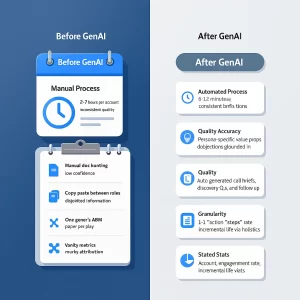
Let’s build this step by step.
Step 1: Define your ICP (for real this time)
Yes, you have an ICP slide. But can your team score accounts the same way on a Tuesday afternoon when everyone’s tired? That’s the bar.
- Inputs you need:
- Firmographics: employee count, revenue band, regions, growth signals
- Technographics: adjacent tools, cloud, data stack, compliance posture
- Buying complexity: number of stakeholders, procurement hoops
- Intent and timing: topics, recency, intensity
- Product fit: what’s easy, what’s edge-case
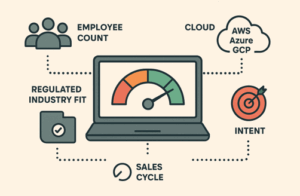
Create a simple scorecard. Make it boring. Make it repeatable.
Tier the output:
- Tier 1 (1:1): 20–50 strategic accounts. Handcrafted, AI-accelerated.
- Tier 2 (1: few): 100–300 clustered by industry/use case.
- Tier 3 (programmatic): 500–2,000 accounts with light personalization.
Step 2: Map the buying committee (and what they actually care about)
| Persona | Role in Deal | Priorities | Typical Objections | Proof That Works |
| CMO / VP Marketing | Budget owner, sponsor | Pipeline, brand safety, speed | “Risky to our brand; show ROI quickly” | Executive one-pager, peer proof, pilot ROI |
| Head of RevOps / MOPs | Technical validator, implementer | Data quality, automation, integration | “This breaks our stack” | Reference architecture, sandbox demo |
| InfoSec / Legal | Gatekeeper | Privacy, compliance (GDPR/CCPA/LGPD) | “Data exposure, AI misuse” | DPA, DPIA template, audit trail, redaction |
| SDR/AE Manager | Day-to-day user | Efficiency, better meetings | “More steps, more tools?” | Copilot demo, saved-time metrics |
You’re not selling to “the account.” You’re selling to a small committee of humans who are busy, skeptical, and risk aware. Make that explicit.
Tiny note: if you don’t explicitly write down “Objections” and “Proof That Works,” your messaging will drift into generic. That’s when replies go silent. Don’t let that happen.
Step 3: Data and governance will be your safety net
ABM powered by AI can be bold without being reckless, but only if you treat data carefully. Use consented first-party data from your CRM or CDP, public sources like websites, filings, PR, and product docs, plus basic enrichment such as firmographics, technographics, and intent signals. Put guardrails in place: respect consent flags, redact PII before prompts, honor regional data laws with pinned storage, limit access by role, and set clear timelines for retention and deletion. Keep logs so prompts and outputs are auditable, especially for Tier 1 content. And remember: your LLM is just another processor under GDPR, CCPA, or LGPD, so map it in your DPIA, and write a one-pager of “allowed sources” versus “prohibited data” so everyone knows the rules.
Step 4: Account research with RAG, not vibes
Raw LLMs can be eloquently wrong. Retrieval-augmented generation (RAG) grounds your outputs in your indexed sources. That means fewer hallucinations and more “oh wow, they did their homework” replies.
Think of RAG like this: read first, write second. You collect a few solid facts, then you ask AI to write only from those facts. It screams “we did our homework.”
What to grab for each account quickly:
- Company website pages: About, Solutions/Products, Case Studies, News/Press
- Financials or big public docs: annual reports, investor decks, letters to shareholders
- Stack signals: careers page (what tools they list), tech docs, partner announcements
- Triggers: leadership changes, new funding, product launches, expansions
- Your own notes: what worked before, what didn’t, quotes from calls (if you have permission)
Where to find it quickly:
| Info you need | Where to look | Why it matters |
| What they do + priorities | Homepage, About, CEO letters, press releases | Tells you what they care about right now |
| Problems they hint at | Case studies, FAQs, job posts (look for pain words) | Reveals gaps, bottlenecks, needs |
| Tech they use | Careers page, engineering blog, partner pages | Helps you talk integration and avoid red flags |
| Recent changes | Newsroom, LinkedIn company page, Google News | Perfect hooks for timely outreach |
| Social proof | Customer logos, awards, analyst mentions | Lets you mirror proof they respect |
You’ll get a brief you can skim in 90 seconds. It will include value hypotheses tied to real initiatives. That’s the difference between “templated” and “useful.”
Step 5: Messaging architecture and guardrails
Think of it like the Russian nested dolls. You start wide, then hone it in layer by layer. The first thing you focus on is your category story. This is your main perspective on the world and what everyone consistently misunderstands. Next, modify that narrative for every segment like u se case, industry, and maturity stage. Then, focus on the account. To avoid coming across as wishful thinking, choose one or two clear value concepts and support them with evidence. Finally, have a conversation with the individual. Every role has different fears and demands different results. Address the concerns they raise, not the ones we wish they had.
Lock this down with guardrails. Bake them into your prompt so the AI stays in bounds. Keep your voice clear, pragmatic, and human. Skip the buzzword salad. Say “Here is the 90-day path” instead of “synergize workflows.” Only make claims you can back up. If you cannot link it or cite it, it does not belong in your pitch. Stay compliant while you are at it. No personal data, never try the guessing game, and always respect consent. Always remember this simple rule of thumb: no internal emails, no personal info ever.
A quick QA checklist (use it every time)
- Is every claim grounded in a citation?
- Does this reflect our actual product capabilities?
- Are we revealing anything sensitive?
- Is there a single, clear next step?
- Would I send this to our CEO without sweating?
if the answer to the above-mentioned question is yes, then you can ship it.
Step 6: Orchestrate plays for Tier1, Tier2, Tier3
Different tiers deserve different efforts throughout the funnel stages. Properly structuring them brings sanity. Adding AI to this mixture brings speed. And both of them added together bring efficiency.
Tier 1: 1-to-1 (Top 20–50 Accounts)
These are your priority accounts, and the outreach should feel hand built. Create a short executive one-pager backed by credible proof points, along with a three-slide deck you adjust for each account. Add a personalized page or a dynamic site block so they see something tailored when they visit. Your SDR team should run a focused sequence which follows this template: first touch → follow-up → objection handling. If you want more impact, send a small direct mail piece with a QR code leading to the personalized page.
Run this in a three-week rhythm. Start with an email to the champion on day one, sharing one clear, evidence-backed value idea. Two days later, follow up with a short LinkedIn InMail referencing the same proof. By day five, launch retargeting ads with an account-specific headline. In week two, share the one-pager and ask for a short value call. In week three, offer something useful like a ROI sketch or sandbox access and follow it up with a call.
Tier 2: 1-to-few (100–300 Accounts by Industry or Use Case)
This tier runs at the cluster level. You don’t need to fully personalize your approach, just adjust the first 30 percent: the intro, proof points, CTAs, and logos. Direct people to a cluster landing page with two strong use cases and anchor the campaign with a roundtable or AMA featuring a customer from that industry.
The cadence is two weeks. In week one, send a proof-led email and turn on retargeting. In week two, send the event invite, then follow up with a short recap and a direct ask.
Tier 3: Programmatic (500–2,000 ICP-fit Accounts)
Here, the focus is on scale. Personalization stays light but visible. Swap the industry headline, proof bar, and CTA on your site so they align with the visitor. Use intent signals and page behavior to trigger playbooks that guide people to the next best step. Refresh creative every 14 to 21 days to keep it relevant.
The structure doesn’t change: target, message, timing. What changes is the level of effort.
Here is Sample copy for each touch point that you can steal (please do)
Email (first touch)
Subject: A 90day path to {Outcome} at {Account}
Hi {FirstName},
I saw that {Account} is leaning into {initiative}. {short evidence with link}. Teams like {peer logo} hit {result} in ~90 days with {Your Solution}, without interfering with {system/process}. If it’s useful, I can share a onepager tailored to your stack and a sandbox walkthrough.
Let’s set you up in about 15–20 minutes next week?
{Rep Name}
LinkedIn opener (short)
Your Q4 letter highlights {initiative}. We helped {peer} cut {metric} by {x%}. Happy to share a onepager scoped to {Account}’s stack.
Ad headline options
- {Industry} teams at {peer} cut {metric} by {x%}—see how
- A 90day plan for {Account}: {Outcome} without {risk}
Step 7: Sales alignment with AI copilots
This is the make-or-break moment. The copilot must feel useful, not like another tab to ignore. Give your SDRs and AEs the ammunition they want to use.
A good copilot should act like the tireless sales intern everyone wishes they had. For every Tier 1 account, it automatically pulls together a one-page call brief with initiatives, talk tracks, and discovery questions. It also drafts first-touch and follow-up emails that are solid enough for SDR approval but they’re never auto-sent, so humans stay in control. After calling, it steps in to summarize the discussion, pull action items, and update the CRM without clutter. And when an opportunity opens, it nudges reps with relevant past wins and customer references, so they don’t start from scratch.
Simple SLAs that keep everyone honest
- Pre-engagement: Marketing warms up at least two personas with 1-to-1 assets. Sales reviews the brief and confirms timing within 48 hours.
- First reply: Marketing alerts immediately and shares the call brief. Sales books and runs discovery. Outreach within 24 hours.
- Post call: Marketing refreshes the account profile and value ideas. Sales logs, structured notes, and next steps the same day.
- Opportunity created: Marketing delivers a reference deck and proof pack. Sales sets a mutual action plan within two days.
Reality check
A copilot won’t save a broken process. It just removes the excuses. If the team already runs good habits, it makes them effortless.
Step 8: Measure what matters (and prove it)
Nice charts sure look cute. But revenue pays the bills. So here’s the short list of things you’d want to track.
Start with coverage: How many of your target accounts have complete profiles and at least one play running? That’s just checking if you’re aiming at the right people.
Then engagement: look for real signals, not vanity clicks. Things like replies, visits to high-intent pages (pricing, security), time spent reading, and meetings booked.
The third piece is pipeline: are Tier 1 accounts creating new opportunities, moving through stages faster, and showing actual revenue influence? That’s just “is money coming in, and is it coming in quicker?” Finally, efficiency: how much time the team is saving per account brief, and what it costs to engage one account. In other words, are you doing more with less?
In the first 90 days, aim for 80% of your list enriched and tiered, 30% of Tier 1s showing at least two engaged contacts, and 10–15% of them opening real opportunities. About a quarter of positive replies should lead to meetings. And if your copilot isn’t saving at least an hour per brief, it’s slacking.
Two habits boost your plan: always run holdouts (leave 10–20% of accounts on the old program so you can measure lift) and prune every quarter (cut dead accounts, spend time on warm ones).
Rollout’s simple.
- Month one: build your ICP scorecard, wire up CRM/CDP, and pilot 30 Tier 1 accounts. The goal is 5–8 meetings.
- Months two and three: scale into Tier 2 clusters, add the copilot to CRM, put up a simple dashboard, and start light personalization for Tier 3.
- By day 90, you should see 10–15% of Tier 1s progressing into opportunities.
Keep it boring, keep it honest. If a metric doesn’t change what you do this week, drop it.
Tooling: build vs buy (choose your battles)
| Category | Buy (Examples) | Build (When it makes sense) | Notes |
| ABM/Intent | VAIS | If you have strong data team + CDP | Faster time to value with buy |
| Data layer | Salesforce/HubSpot + Segment/mParticle + Snowflake/BigQuery | If bespoke data model is a moat | Keep lineage; document it |
| GenAI models | OpenAI, Anthropic, Cohere; Llama 3 (self-host) | If data sensitivity or cost control matters | Start hosted; revisit later |
| Retrieval | Pinecone, Weaviate, Elastic, pgvector | If your infra team loves Postgres | Hybrid search (BM25 + embeddings) wins |
| Orchestration | LangChain, LlamaIndex, custom APIs | If workflows are unique | Keep prompts/versioning in Git |
| Personalization | Mutiny, Adobe Target, Optimizely | If your CMS is flexible | Start with dynamic blocks |
Guardrails and safety (because “oops” is expensive)
The golden rule is data minimization, only feed your model what it needs. Strip out personal details, keep it to role and context. In your prompts, be blunt: tell the model to use only the sources provided, cite everything, and never guess. Every public-facing asset should run through toxicity and brand filters so nothing embarrassing slips through. For Tier 1 executive materials, a human review is non-negotiable before anything gets sent. And don’t skip the boring part: keep clear logs of who created what, when, and with which sources. When something inevitably gets questioned, those records will save you.
Common pitfalls (and what to do instead)
1. Thin personalization
-
- Smells like: “Saw you’re hiring! We help companies like yours…”
- Fix: Tie value to a documented initiative with a citation. Always.
2. Hallucinated claims
- Smells like: “We helped Company X with Y” (but… did you?)
- Fix: RAG with curated sources. No source, no claim.
3. Over-automation
- Smells like: 17 cold emails fired with zero human eyes.
- Fix: Human review for Tier1. SDRs edit, not just send.
4. Data sprawl
- Smells like: “Where did this asset come from?” (everyone shrugs)
- Fix: Version prompts, log outputs, centralize approvals.
5. Compliance gaps
- Smells like: “Wait, we used what data where?”
- Fix: Write a one-page policy. Train. Audit quarterly.
Prompts you can copy today (bookmark these)
- Account brief (concise, executive-ready)
“Create a 200–250 word account brief for {Account} in {Industry}. Use only the provided sources. Include 3 initiatives, 3 pains, 2 value hypotheses with citations, and 3 discovery questions. Tone: pragmatic. Output in bullets.” - Persona objection handling
“For a {Role} at {Account}, list the top 3 objections to {Use Case} and provide 2 data-backed responses for each, with links. Keep each response under 40 words.” - 1:1 landing page microcopy
“Draft hero (10 words), subhead (18–24 words), 3 bullets (7–10 words each), and a proof bar referencing {Source}. Tone: confident, specific. No hype.” - SDR follow-up (after site visit)
“Write a 90word follow-up to {First Name} at {Account} referencing their visit to {Page} and interest in {Topic}. Offer a 20-minute ‘value hypothesis’ call. No fluff.”
Measurement nerd corner (optional but powerful)
- Account Engagement Score (AES) = 3 × email replies + 2 × highintent pageviews + 1 × time-on-page minutes + 4 × meetings set
- Pipeline Velocity = (Open Pipeline × Win Rate × ACV) / Sales Cycle Days
- Incrementality = (Test tier opps − Control tier opps) / Control tier opps
Keep it simple. Make a dashboard, yes. But more importantly: run a weekly 30-minute review where marketing and sales pick three accounts to push forward, together. That meeting is where trust—and pipeline—happens.
Mini FAQ (because you’ll get asked)
- Do we need a vector database on day one?
- Not necessarily. If your corpus is small, pgvector or even Elastic with hybrid search can do the job. Start simple.
- Open-source LLM or hosted?
- Start hosted. Validate the workflow. If/when privacy, cost, or latency demand it, bring parts in-house.
- How do we prevent brand mishaps?
- Guardrails + automated checks + human review for Tier1. Also: a “words to avoid” list works wonders.
- What about cookie deprecation?
- Great prompt to double down on firstparty data and server-side tracking. ABM thrives on consented data anyway.
P.S. Don’t let the robots write cheques your product can’t cash. Evidence first. Always.