
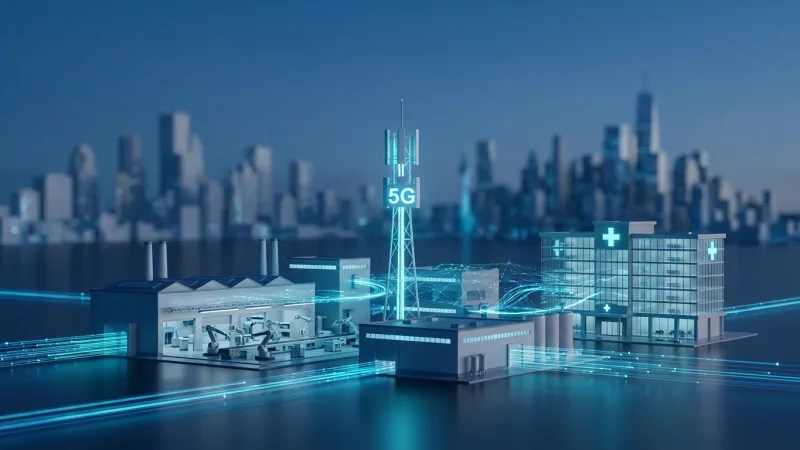
While 73% of enterprises plan 5G deployment by 2025, only 12% have moved beyond pilot projects. Why is it that a majority are still stuck in the planning phase? The answer lies in understanding real 5G enterprise use cases. This article will explore 12 practical applications generating immediate ROI, helping you see past the hype to the real-world value of 5G. Armed with this information, you can determine whether your business will be part of the 61% still planning or the 12% reaping the benefits.
5G Enterprise Use Cases: Beyond the Hype to Real Business Value
There’s a $1.3 trillion projected enterprise 5G market by 2030, but how do businesses extract this value beyond marketing promises? 78% of enterprises plan 5G deployment by 2025, expecting an average 23% operational efficiency gain. However, connecting these gains to specific 5G enterprise use cases is important for actual ROI.
| Aspect | 4G Applications | 5G Applications |
| Speed | 100 Mbps | 10 Gbps |
| Latency | 50 ms | 1 ms |
| Capacity | 1,000 devices/km² | 1,000,000 devices/km² |
| Reliability | 99.9% uptime | 99.999% uptime |
Among the many technical aspects, 5G’s speed, ultra-low latency, and high capacity are game-changers. Imagine the impact on industrial automation, where every millisecond matters. The best approach is to assess 5G’s fit through a capability framework, which highlights its unique strengths in speed, latency, capacity, and reliability.
Manufacturing and Industrial 5G Business Applications
Manufacturing stands as the largest segment for 5G enterprise use cases. With smart factory automation, companies are reducing downtime by 35% and preventing $50 million in annual losses through predictive maintenance.
Consider the BMW Munich factory, which integrated 5G for real-time quality control using computer vision. Their adoption of predictive maintenance has decreased unexpected equipment failures by over 30%, translating into immediate cost savings.
| Use Case | Operational Efficiency | ROI Timeline |
| Smart Automation | 35% downtime reduction | 12 months |
| Predictive Maintenance | 30% failure reduction | 18 months |
| Real-Time Quality Control | 10% defect reduction | 8 months |
The matrix above shows clear efficiency improvements and ROI timelines. By implementing 5G now, manufacturing businesses can achieve significant operational gains and cost savings sooner than later.
Private 5G Networks: Security and Control for Enterprise
Private 5G networks offer a important differentiation from public networks, with a 99.99% uptime guarantee compared to 99.5% for public networks. They also provide data sovereignty, which is important for enterprises prioritizing compliance.
These networks allow customizable slicing for specific applications, ensuring that each slice gets the required resources. This customization improve security and operational efficiency. For example, private 5G ensures that critical applications are never bogged down by less urgent data streams.
| Network Type | Uptime Guarantee | Customization |
| Private 5G | 99.99% | Full control |
| Public 5G | 99.5% | Limited control |
The cost-benefit analysis worksheet for private 5G highlights long-term savings and improve security. This investment provides the control necessary for high-stakes applications.
Healthcare and Medical 5G Enterprise Solutions
5G’s ability to support remote surgery with 1ms latency requirements offers unprecedented opportunities for the healthcare sector. Real-time patient monitoring reduces readmissions by 28%, proving its critical value.
Managing medical IoT devices at scale becomes feasible with 5G, which can handle vast data volumes. These applications, backed by measurable business outcomes, make 5G investments justifiable even for cost-conscious healthcare providers.
| Application | Impact | Required Bandwidth |
| Remote Surgery | 1ms latency | 10 Gbps |
| Patient Monitoring | 28% readmission reduction | 1 Gbps |
| IoT Device Management | flexible management | 500 Mbps |
use the 5G ROI calculator to determine the financial benefits of deploying 5G technologies in your healthcare setting. This, combined with a regulatory compliance checklist, ensures a smooth transition to 5G capabilities.
Smart City and Infrastructure 5G IoT Applications
5G enables smart city initiatives by providing massive IoT connectivity. Traffic improve reduces congestion by 40%, and smart grid management prevents costly blackouts.
Barcelona serves as a model smart city, integrating over 10,000 sensors per km² to monitor environmental factors. Their 5G deployment roadmap showcases how cities can change connectivity into practical insights.
| Infrastructure Element | 4G Cost | 5G Cost |
| Traffic Management | $500,000/year | $300,000/year |
| Smart Grid | $1M/year | $750,000/year |
| Environmental Monitoring | $600,000/year | $400,000/year |
The infrastructure cost comparison table demonstrates the financial benefits of investing in 5G over 4G for IoT applications. The roadmap provides a strategic guide for integrating 5G into urban infrastructure.
Retail and Customer Experience 5G Innovations
Retailers are seeing a 67% increase in conversion rates by using AR/VR shopping experiences enabled by 5G. Real-time inventory management ensures product availability across locations, improving customer satisfaction.
Personalized in-store experiences powered by edge AI deliver targeted promotions and improve brand loyalty, turning 5G into a powerful tool for driving revenue growth.
| Aspect | Pre-5G | Post-5G |
| Conversion Rate | 3% | 5% |
| Inventory Accuracy | 80% | 95% |
| Customer Satisfaction | 70% | 85% |
Examine the retail 5G technology stack diagram to understand the components required for these transformations. The implementation timeline offers steps to achieve these results efficiently.
5G Enterprise Implementation: Roadmap and Best Practices
Moving from theory to practice, a phased deployment approach minimizes disruption during 5G implementation. Developing clear vendor selection criteria and use RFP templates simplify the process.
Change management and training for the 5G workforce are critical. A detailed 12-month implementation checklist and budget planning worksheet highlight hidden costs and guide successful rollouts.
Addressing risks with a mitigation framework ensures you’re prepared for potential challenges. This complete view provides the clarity needed to avoid pitfalls and seize the opportunities 5G offers.
Conclusion
To gain the upper hand with 5G enterprise use cases, start by mapping specific applications to your business needs. Identify areas ripe for innovation, such as manufacturing automation or retail experience enhancements. Begin your journey today by crafting a tailored 5G deployment plan, and improve your position from planning to thriving.
What are the main 5G enterprise use cases? The main 5G enterprise use cases include smart manufacturing, healthcare innovations, private networking, smart city IoT, and retail enhancements. These applications use 5G’s speed and reliability to deliver measurable business outcomes. How do businesses benefit from 5G technology? Businesses benefit from 5G through improved operational efficiency, improve customer experiences, and increased capacity for IoT applications. The result is simplify operations and significant cost savings. What is private 5G and why do enterprises need it? Private 5G networks offer enterprises full control and improve security over their network environments. This ensures uptime reliability and customized resource allocation for critical applications. How much does 5G enterprise implementation cost? The cost of 5G enterprise implementation varies based on scope and scale, but it generally involves expenses related to infrastructure upgrades, device compatibility, and maintenance, often offset by long-term efficiencies and ROI.