
While 83% of cloud architects struggle to choose between serverless and containers, new benchmark data reveals the decision isn’t about which is ‘better’—it’s about matching architecture to workload DNA. Imagine you’re choosing between two powerful tools, each uniquely suited to specific tasks. Misalignment could mean lost revenue or time wasted on inefficient processes. In this article, you’ll discover a complete decision framework that maps specific workload characteristics to architecture choices using real performance benchmarks and TCO calculations. By the end, you’ll know exactly how to align your workloads for optimal efficiency and cost-effectiveness.
Serverless vs Containers: Architecture Fundamentals Explained
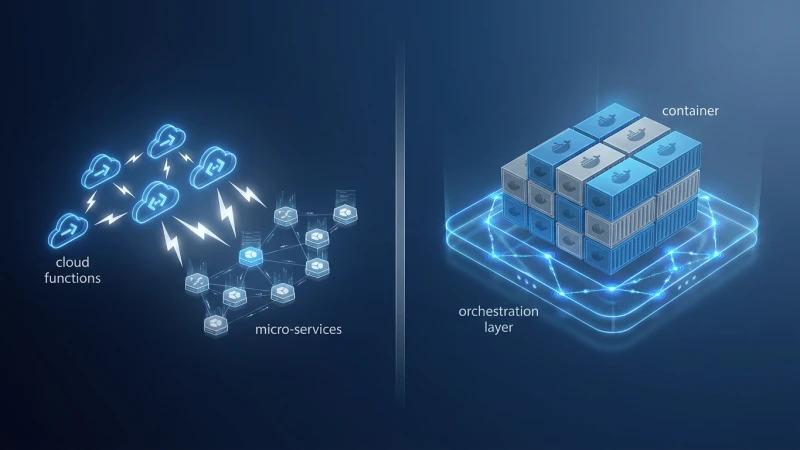
When it comes to serverless vs containers, understanding the foundational differences is important. Serverless architecture operates on an event-driven execution model, triggering functions in response to events. Imagine deploying functions without worrying about infrastructure. In contrast, containers are ideal for applications with persistent execution models, maintaining state across sessions.
One of the core differences lies in how they handle state. Serverless is inherently stateless, ideal for functions that start and complete independently. Containers, however, can manage stateful applications requiring persistent data storage. This fundamental difference affects everything from scaling to resource allocation.
| Aspect | Serverless | Containers |
| Execution Model | Event-driven | Persistent |
| State Management | Stateless | Stateful |
| Auto-scaling | Automatic on demand | Manual or Managed |
| Resource Allocation | Dynamically allocated | Fixed or Elastic |
To simplify, serverless applications automatically scale within milliseconds, making them perfect for varying demand. Containers offer more control over resources, suitable for applications requiring steady resource allocation. Deciding between them is less about superiority and more about alignment with your workload’s technical needs.
Performance Benchmarks: Real-World Speed and Scalability Tests
Performance is the heartbeat of architecture choice. In the serverless vs containers debate, real-world benchmarks provide clarity. Cold start latency, a common concern with serverless, often clocks at 100-300 ms. Containers, however, generally avoid this delay, initializing almost instantly, which could be important for latency-sensitive applications.
| Metric | Serverless | Containers |
| Cold Start Latency | 100-300 ms | < 50 ms |
| Auto-scaling Response | < 1 sec | 1-2 mins |
| Concurrent Execution | Limited by vendor | Defined by resources |
| Memory/CPU Efficiency | improve for scale | improve for control |
Auto-scaling in serverless platforms can be near-instantaneous, outperforming containers, which may take minutes to spin up new instances. However, containers shine in environments needing predictable scaling based on resource parameters. For example, if your application experiences predictable daily traffic spikes, containerized environments may provide more consistent performance.
Memory and CPU efficiency also varies: serverless improve automatically, whereas containers require manual tuning. Understanding these nuances ensures you’re using the right tool for the job, avoiding potential bottlenecks in your application flow.
Total Cost of Ownership: Beyond Simple Pricing Models
Costs can dramatically swing the serverless vs containers pendulum. At first glance, serverless might seem cheaper with its pay-per-execution model. However, development and maintenance costs can add layers of complexity. Containers often incur predictable reserved capacity costs, which may align better with certain long-term applications.
Consider this scenario: a serverless application might incur $0.20 per million requests, while a containerized application might require a $50/month reserved instance. At scale, both costs could balance out, but hidden expenses like debugging and monitoring might tip the scale towards one.
Vendor lock-in is another factor. Serverless is often tightly coupled with specific providers, whereas containers offer more flexibility through orchestrators like Kubernetes. Lack of portability in serverless could increase future migration costs, making containers a more viable long-term strategy.
To navigate these complexities, consider using a TCO calculator to forecast costs based on your workload. This enables you to factor in monitoring, debugging, and potential vendor lock-in scenarios, aligning your budget with your architecture choice.
The Workload Decision Matrix: Choosing the Right Architecture
When deciding between serverless and containers, aligning architecture with workload is key. Let’s break down the decision process using a detailed matrix. Analyze traffic patterns: are they sporadic or steady? Serverless thrives in environments with unpredictable spikes, while containers suit steady, predictable loads.
Consider processing complexity and state management needs. Serverless easily handles simple, stateless functions, whereas containers are better for complex, stateful applications. Integration complexity also plays a role. Serverless excels in environments with minimal external dependencies, while containers can manage intricate integrations smooth.
Using this decision matrix, you can classify workloads and match them with the optimal architecture. For instance, an API with inconsistent traffic could benefit from serverless, while a high-volume, stateful application might perform better in a containerized environment.
Implementation Strategies for Each Architecture
Understanding theory is one thing; implementing it is another. For serverless, deployment best practices involve use tools for automated CI/CD pipelines. This accelerates development cycles, ensuring quick rollouts of new features. In contrast, container orchestration requires setting up systems like Kubernetes for efficient management.
Migration strategies from monolithic architectures to serverless or containers differ significantly. Serverless requires breaking down applications into discrete functions. Containers may involve refactoring applications to modular services, providing a clearer path for monoliths transitioning to microservices.
Considerations for DevOps pipelines also vary. Serverless integrates smooth with continuous deployment, while containers might require more strong CI/CD setups. These strategies change theoretical knowledge into practical steps, ensuring your architecture choice delivers tangible benefits.
Hybrid Approaches: When to Combine Serverless and Containers
Why choose when you can combine? Hybrid architectures blend the best of serverless and containers, offering flexibility and power. For instance, use serverless for API gateways while deploying processing-heavy tasks in containers. This strategy maximizes efficiency and cost-effectiveness.
Consider data processing pipelines: serverless can trigger data ingestion events, while containers handle complex processing tasks. This division plays to each architecture’s strengths, improve performance. Cost improve is another benefit. Use serverless for variable workloads, switching to containers for predictable processes.
Real-world examples show companies reducing costs by 20% and improving performance by blending these architectures. This hybrid strategy isn’t just advanced—it’s future-ready, positioning your applications to adapt to changing demands smoothly.
Future-Proofing Your Architecture Choice
Making your architecture future-proof involves anticipating changes. Serverless technology is evolving, with trends like increased vendor flexibility and edge computing options. Meanwhile, containers are expanding capabilities, integrating AI to automate orchestration tasks.
Multi-cloud strategies are becoming important. They improve reliability and performance, preventing vendor lock-in. Also, keep an eye on emerging technologies that might disrupt the serverless vs containers debate. Whether it’s serverless edge solutions or improve container orchestration, staying informed is important.
To prepare for these changes, use a future readiness checklist. This ensures your architecture remains resilient, adaptable, and aligned with technological advancements, securing your workloads for years to come.
Conclusion
The best action you can take today is to evaluate your current workloads using our decision matrix. Assess traffic patterns, processing needs, and integration complexities to choose the architecture that aligns perfectly with your goals. For more insights, explore our 10 Cloud Cost improve Strategies Save 30-50% on Bills and other related resources. The serverless vs containers debate isn’t about picking a winner, it’s about finding the right fit for your unique needs. Embrace the choice, implement strategically, and future-proof your architecture for sustained success in the dynamic cloud market.
FAQ
What is the main difference between serverless and containers? Serverless operates on an event-driven, stateless model, automatically scaling with demand. Containers, however, offer a persistent, stateful environment. They provide more control over resource allocation and are ideal for applications needing steady, predictable resource management. When should I choose serverless over containers? Choose serverless for workloads with unpredictable traffic and simple, stateless functions. It’s particularly effective for functions that don’t require constant resource allocation, as it automatically scales with demand, saving costs on unused capacity. Are containers more cost-effective than serverless? Containers can be more cost-effective in scenarios with predictable resource demands, providing fixed costs with reserved capacity. They allow customization and control over resources, which can reduce costs when pricing models align with your application’s needs. Can I use both serverless and containers together? Absolutely! Hybrid architectures use both serverless and containers, maximizing strengths of each. For instance, use serverless for API gateways and containers for complex processing tasks, improve performance and cost-effectiveness. What are the performance differences between serverless and containers? Serverless may experience cold start latency, typically 100-300 ms. Containers offer near-instant start times. Auto-scaling in serverless is faster, but containers provide consistent resource control. Understanding these differences helps improve your architecture choice.