
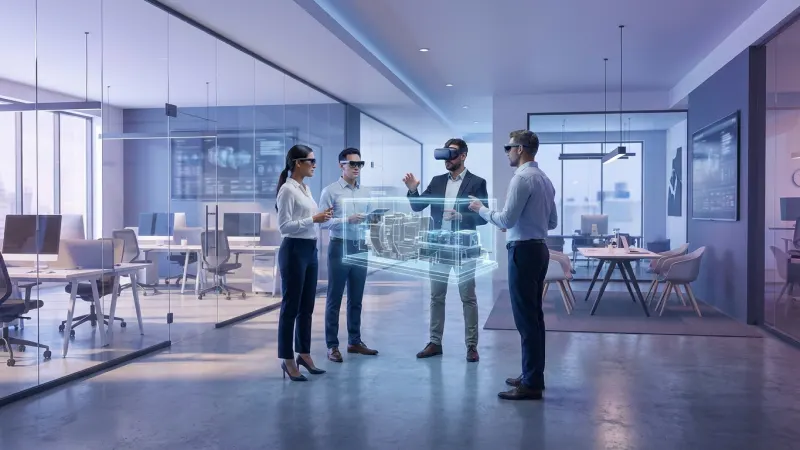
While 73% of enterprises plan AR/VR investments in 2024, only 23% of pilot programs scale to full deployment. Here’s what the successful 23% did differently to achieve substantial benefits. In this article, you will discover a 5-step framework detailing how companies effectively implemented AR and VR technologies, leading to real business outcomes. From quantified training improvements to design cycle reductions, we cover every facet of enterprise AR VR use cases. Let’s dive in.
Enterprise AR VR Market Reality: $31.8B Investment vs. Actual Results
In 2022, enterprises globally invested $31.8 billion in AR and VR technologies. Despite this massive spend, only a small fraction of deployments have realized their full potential. Why? A significant gap exists between AR VR hype and tangible results. For instance, while 73% of businesses show interest in these technologies, just 23% have successfully scaled their implementations beyond pilot phases.
Common failure points include inadequate change management, lack of clear business objectives, and underestimated technical challenges. Industry adoption varies widely, with sectors like healthcare and automotive leading the charge, while others lag behind. This discrepancy highlights the need for a detailed enterprise readiness assessment framework to evaluate technological compatibility and organizational agility.
| Year | Market Size ($B) | Success Rate (%) |
| 2022 | 31.8 | 23 |
| 2023 | 37.2 | 27 |
| 2024 (Projected) | 43.5 | 30 |
AR vs VR Decision Matrix: When to Choose Which Technology
Navigating the AR vs VR decision isn’t always straightforward. Start by evaluating technical requirements. VR generally demands more infrastructure and has higher upfront costs, while AR can integrate into existing workflows more smoothly. Consider use case suitability: VR excels in immersive training scenarios, while AR shines in remote assistance and real-time expert support.
Complexity of implementation can be evaluated using a decision matrix. This matrix should consider factors like budget, timeline, and workforce readiness. Here’s a technical requirements checklist to guide you:
| Criteria | AR | VR |
| Initial Cost | Lower | Higher |
| Infrastructure Needs | Minimal | Extensive |
| Best Use Case | Remote Assistance | Training Simulations |
VR Training Programs: 23 Documented Case Studies with Performance Data
Consider Walmart’s VR training program, which resulted in a 30% increase in employee retention by offering immersive learning experiences. Boeing effectively reduced assembly errors by 25% through VR training. Medical simulations using VR have improved accuracy rates in complex procedures by up to 40%, providing safe environments to rehearse high-stakes scenarios.
VR’s ability to replicate real-world conditions means safety training programs see substantial improvements. For example, mining companies have reported a 60% reduction in workplace accidents after implementing VR-based safety training.
| Company | Performance Metric | Improvement (%) |
| Walmart | Employee Retention | 30 |
| Boeing | Assembly Errors | 25 |
| Healthcare | Procedural Accuracy | 40 |
| Mining | Workplace Safety | 60 |
AR Remote Assistance: Real-Time Expert Support Implementation Guide
AR remote assistance is accelerating field service operations, evidenced by Microsoft HoloLens deployments that have increased service efficiency by 50%. These platforms enable real-time expert guidance, reducing response times and improving troubleshooting accuracy. In sectors like manufacturing, AR has proven instrumental in expediting expert knowledge transfer, directly impacting productivity.
Implement an AR remote assistance platform by first assessing your technology stack requirements. An efficient rollout can be achieved with a clear implementation timeline outlining key milestones:
| Phase | Description | Timeframe |
| Assessment | Technology stack evaluation | 1-2 weeks |
| Deployment | Platform setup and initial training | 3-4 weeks |
| Scaling | Full integration and improve | 4-6 weeks |
Design and Prototyping: How Ford and BMW Reduced Development Cycles by 40%
Ford and BMW have used AR and VR in their design processes to cut development cycles by 40%. By visualizing prototypes in a virtual environment, these companies have simplified design workflows and improved collaboration. Architects use AR to showcase building designs in real-world contexts, boosting client understanding and speeding up approval processes.
In terms of collaborative design, AR and VR platforms enable real-time changes and feedback loops, reducing downtime and accelerating time-to-market. Here’s a development cycle comparison illustrating these efficiencies:
| Company | Metric | Reduction (%) |
| Ford | Development Cycle | 40 |
| BMW | Design Time-to-Market | 35 |
Enterprise Collaboration Platforms: Teams Working in Virtual Spaces
Virtual collaboration spaces are changing team dynamics in enterprises, driving productivity gains and improving spatial collaboration. For instance, teams report a 25% increase in engagement during virtual meetings compared to traditional formats. Platforms are enabling more effective remote team interactions, building an environment where creativity flourishes.
With virtual workspaces, geographical barriers fade away. This is important for distributed teams seeking seamless collaboration. Check the collaboration platform comparison for insights into user adoption strategies:
| Platform | Engagement Improvement (%) | Productivity Increase (%) |
| Virtual Office | 25 | 20 |
| Traditional Setting | 15 | 10 |
Implementation Roadmap: 90-Day Enterprise AR VR Deployment Strategy
Ready for deployment? A structured 90-day roadmap is important to transition from pilot to full-scale. Begin with decision-makers alignment to ensure everyone is on board. Evaluate technology criteria meticulously and design pilot programs tailored to your organizational needs. Finally, scale with confidence using proven strategies.
This roadmap will guide you through a successful rollout, with budget planning templates and a strong success metrics framework:
| Stage | Key Activities | Duration |
| Alignment Phase | decision-makers engagement | 2 weeks |
| Evaluation | Technology and pilot program design | 3 weeks |
| Scaling | Smooth transition to full deployment | 5 weeks |
Conclusion
To access the full potential of AR VR enterprise use cases, start your journey with a detailed readiness assessment and choose solutions that perfectly match your business needs. Then, apply our 90-day roadmap to navigate deployment smoothly. As enterprises continue to increase AR and VR investments, those who strategically implement will lead the market with new solutions. For more insights, visit our homepage.
FAQ
How is AR/VR used in enterprise?
AR/VR in enterprise use cases include training, design visualization, remote assistance, and collaboration platforms. Each use case offers specific advantages like improved learning outcomes or improved real-time collaboration, making them important tools for modern businesses.
What are enterprise VR use cases?
Enterprise VR use cases cover training simulations, design prototyping, and virtual client presentations. These applications capitalize on VR’s immersive nature, enabling realism and engagement that traditional methods can’t match.
What is the ROI of enterprise AR VR training?
Enterprise AR VR training can deliver significant ROI, with results such as 25% error reduction and 40% improved procedural accuracy. The immersive nature of these technologies improves retention and skill acquisition.
Which industries benefit most from AR VR enterprise solutions?
Industries like healthcare, automotive, and manufacturing gain the most from AR VR solutions. They use these technologies for better training, design, and remote assistance, improving efficiencies and reducing costs.