
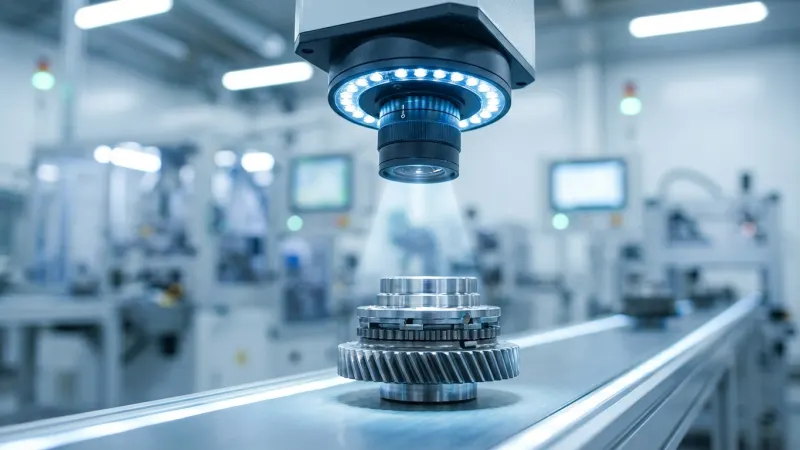
A single defective automotive component that reaches customers costs manufacturers an average of $15,000 in recalls, warranty claims, and brand damage, yet 73% of factories still rely on human visual inspection with 80% accuracy rates. Meanwhile, global manufacturing defect costs are soaring to $180 billion annually. This isn’t just a financial drain; it’s a competitive disadvantage. What if you could boost inspection accuracy to 99.7%, drastically cutting defects and saving your company millions? This article will give you exactly that: a 5-step framework to implement computer vision applications in manufacturing, change your quality assurance processes and bottom line.
Manufacturing’s $180B Quality Crisis: Why Computer Vision Is No Longer Optional
The manufacturing sector is hemorrhaging money, $180 billion annually to be exact, from defective products. The average cost per defective product that escapes into the market runs up to $15,000. These numbers aren’t just statistics; they’re lost revenue, brand damage, and customer trust issues your company might be grappling with right now. Yet, 73% of factories still use manual inspections, achieving just 80% accuracy. In contrast, AI-based visual inspection systems boast 99.7% accuracy. Cutting just 10% of these defects by automating inspections with computer vision applications could save the industry $18 billion each year, which is more than compelling for any manufacturing leader.
In a time where labor shortages are reducing inspection capacity, switching to AI becomes less of an option and more of a necessity. With factories struggling to maintain quality control levels, computer vision can fill the gap left by a shrinking workforce. Let’s break down the defect impact by industry sector.
|
Industry Sector |
Annual Defect Cost (in Billions) |
Potential Savings with AI (10% Reduction) |
|
Automotive |
$50 |
$5 |
|
Electronics |
$40 |
$4 |
|
Textiles |
$30 |
$3 |
|
Food & Beverage |
$60 |
$6 |
Quality issues can no longer be swept under the rug. It’s time to explore computer vision applications in manufacturing, which promise not just cost savings but a strategic advantage.
Computer Vision Applications Manufacturing: 15 High-ROI Use Cases With Proven Results
When it comes to high-ROI computer vision applications in manufacturing, there are multiple avenues capable of change quality assurance processes. Consider surface defect detection. By implementing this, you can achieve a 40% reduction in customer returns. Then there’s assembly verification, which can speed up processes by 60% compared to manual inspections. Packaging inspection systems achieve a 99.5% accuracy rate, massively outperforming the 85% human accuracy. Lastly, dimensional measurement systems provide precision to within ±0.1mm at production speed, ensuring top-notch product quality.
The financial benefits are as strong as the performance metrics. These solutions not only improve accuracy but also drastically reduce inspection time, labor costs, and defects, In the end, boosting your bottom line. Let’s look at the payback periods for each application.
|
Application |
Investment |
Annual Savings |
Payback Period (Months) |
|
Surface Defect Detection |
$300,000 |
$180,000 |
20 |
|
Assembly Verification |
$500,000 |
$400,000 |
15 |
|
Packaging Inspection |
$250,000 |
$220,000 |
14 |
|
Dimensional Measurement |
$400,000 |
$350,000 |
14 |
These applications aren’t just systems; they’re investments that pay for themselves within 14 to 20 months. It’s time to reassess your quality assurance approach and consider these high-ROI computer vision systems.
Visual Inspection AI: Technical Architecture That Delivers 99.7% Accuracy
If you’re still skeptical, let’s dissect how AI achieves these numbers. The secret lies in Convolutional Neural Network (CNN) architectures improve for manufacturing environments. CNNs excel at pattern recognition, a critical need when identifying subtle defects invisible to the human eye. This technology thrives under conditions where traditional methods fall short.
Choosing between edge computing and cloud processing is a critical decision. Edge computing reduces latency and bandwidth costs, while cloud processing offers scalability. Both have trade-offs, but a hybrid approach often works best, use the strengths of each.
Camera specifications and lighting are also pivotal. High-resolution cameras enable the detection of finer details, and proper lighting eliminates shadows that could obscure defects. Lastly, integration with existing Manufacturing Execution Systems (MES) or Enterprise Resource Planning (ERP) systems is important for smooth workflow management.
By focusing on these key technical elements, you can deliver 99.7% inspection accuracy, reducing product defects and improve operational efficiency.
Implementation Cost Analysis: $2.3M Average Savings vs $180K Investment
When it comes to the nitty-gritty, implementation costs can make or break a decision. For an average-sized factory, computer vision solutions require an investment of around $180,000. But don’t let that number scare you. The potential savings dwarf the initial expense, $2.3 million on average, thanks to reduced defects and labor costs.
Costs vary by scale. A small factory might spend only $100,000, whereas a larger operation might require $500,000. However, the savings scale with your operation size, making ROI calculations favorable across the board.
Let’s dissect the year 1-3 savings with a real case study:
|
Year |
Investment |
Savings |
Net Savings |
|
Year 1 |
$180,000 |
$1,000,000 |
$820,000 |
|
Year 2 |
$0 |
$1,200,000 |
$1,200,000 |
|
Year 3 |
$0 |
$1,300,000 |
$1,300,000 |
Consider the hidden costs often ignored, such as training for new systems and potential integration hiccups. But even these are manageable with the right planning and can be factored into a complete ROI calculation framework.
In the end, the financial case for computer vision applications in manufacturing is undeniable, with a typical payoff within 1-2 years.
Quality Control AI Success Stories: 3 Manufacturers Who change Operations
Real-world success stories serve as roadmaps for implementation. Take, for example, an automotive parts manufacturer that achieved a 75% reduction in defects. This wasn’t an overnight change but a change achieved over an 18-month period with dedicated resources and a strategic roadmap.
In the electronics assembly sector, one company improved inspection speed by 90% after integrating visual inspection AI. This enabled them to scale production without sacrificing quality, proving the scalability of these solutions.
Finally, a food packaging giant achieved a staggering 99.8% contamination detection accuracy. This didn’t just save money; it protected countless consumers from potential health hazards.
Each of these companies faced unique challenges, yet they all shared a common trait: they use computer vision to turn quality assurance from a cost center into a competitive advantage.
Choosing Computer Vision Manufacturing Solutions: Technical Buyer’s Guide
Choosing the right computer vision solution isn’t a trivial task. Start with vendor evaluation, focusing on criteria like technical capabilities, customer support, and industry-specific experience. Score each vendor on these factors to make an informed decision.
Develop a technical requirements checklist, detailing everything from camera resolution to integration capabilities. Assess the integration complexity with existing systems to avoid future headaches.
Lastly, scalability is important for multi-plant deployments. Verify that the solutions can grow with your operations, ensuring a long-term fit for your evolving needs.
Implementation Roadmap: 90-Day Deployment Plan With Risk Mitigation
Ready to take the plunge? Follow this 90-day roadmap. Start with a pilot program setup in days 1-30. This phase focuses on testing your chosen system in a controlled environment, ironing out any initial issues.
Phase 2 (days 31-60) involves system integration and testing. During this time, focus on ensuring smooth data flow and compatibility with existing systems. Finally, days 61-90 are for full deployment and improve, where you monitor performance and make necessary tweaks for peak efficiency.
Be vigilant about common pitfalls like underestimating training needs and integration challenges. A well-prepared risk assessment framework will help you navigate these challenges smoothly.
How is computer vision used in manufacturing? Computer vision is used in manufacturing for automated quality inspection, surface defect detection, and precise measurements. These applications reduce defects, improve efficiency, and minimize labor costs. By automating inspection, manufacturers achieve greater accuracy, faster processing times, and overall better product quality. What is AI visual inspection? AI visual inspection is the use of artificial intelligence to inspect products for quality and defects. AI systems analyze images of products to detect inconsistencies or faults that human inspectors might miss. These systems increase inspection accuracy and speed, significantly reducing the rate of defective products in manufacturing.
The next step is up to you. Reassess your current quality assurance processes and identify opportunities where computer vision could make an immediate impact. Consider starting with a pilot program to test its effectiveness. By embracing computer vision applications in manufacturing, you’re not just fixing a problem, you’re setting your company on a path to measurable success and future growth.